What is an AI-native CRM?
Four criteria, one test, and the honest tool list for 2026
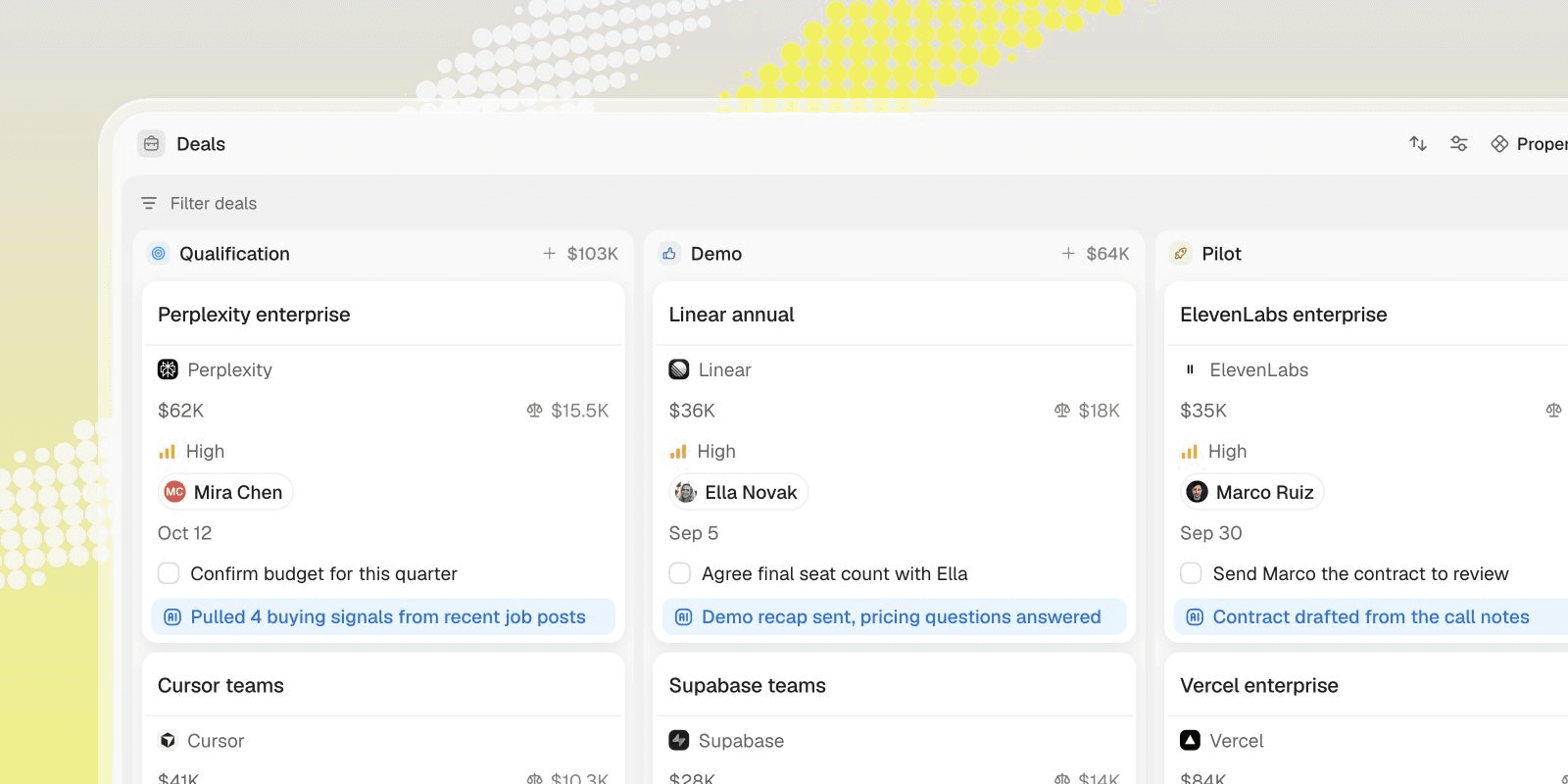
An AI-native CRM is a customer relationship management system designed around AI agents from the first commit. The agents do the record keeping, enrichment and follow-up, and the humans do the selling. Nobody logs in to do admin, because the record keeps itself. Zero is an AI-native CRM for startups built this way. Clarify, Ahoy, Lightfield and Folk are the other tools startup teams shortlist, and Attio sits between the generations: a strong CRM database with AI added later.
Santtu Koivumäki, co-founder· · Updated · 9 min read

The term matters because a wave of products now carries an AI label, and most of them are the old architecture with new features on top. This page defines the category, gives you four criteria and one quick test to run any vendor against, and lists the AI-native CRMs startup teams actually evaluate, including our competitors, fairly.
How we wrote this
We build Zero, one of the tools in this category, so read this the way you would read any vendor's definition page. Three rules keep it useful, the same ones as every page on /compare: we name where competitors are genuinely better, we re-verify every price at source and print the date, and a real person signs it. If something here is wrong or stale, write to hello@zero.inc and I will fix it.
The four criteria
A CRM is AI-native when it passes all four. Most products with an AI label pass one or two.
1. Built for agents from day one, not retrofitted
Architecture is destiny. A product designed around agents gives them the data model, the permissions and the context to act. A product that added AI to a finished CRM gives the AI whatever the old architecture happens to expose. You can usually date the difference: check when the product launched and when its AI shipped. If there is a gap of several years, you are looking at a retrofit.
2. One unified customer record
Agents act on what they can see. If contacts live in the CRM, leads in a sourcing tool, emails in an inbox plugin and enrichment in a third product, no agent sees the whole customer. It sees fragments, and it automates fragments. An AI-native CRM holds the complete record in one place: contacts, companies, emails, meetings, pipeline, enrichment and product signals on one schema.
3. Agents do the data entry
This is the defining output. After every call, email thread and meeting, the record updates itself. Contacts are created, fields filled and next steps logged without a human typing them in. The old deal was that salespeople paid a data entry tax to keep managers' dashboards accurate, and mostly refused to pay it, which is why every incumbent CRM's numbers are fiction by Friday. The point of removing the tax is not comfort. It is that a five person team can run the pipeline coverage of a fifty person org.
4. You talk to it in natural language
Filters, views and reports answer questions you set up in advance. An AI-native CRM answers the question you actually have, such as "which deals stalled after a pricing call?", in plain language, because the agent layer can query the whole record. If the primary interface is still form fields and saved views with a chat window bolted to the side, apply criterion 1.
The subtraction test
If you only have time for one check, use this one: take every AI capability out of the product. Could the vendor still sell what is left to the same customer, at a price that is not dramatically lower?
- Yes, the product still works and still sells. Then the AI is a feature on something that was already whole, and the product is not AI-native.
- No, the product stops making sense without it. Then the AI is the product, and it is AI-native.
Salesforce without Agentforce is still Salesforce, sold to the same buyer at the same price. It was a complete product for twenty years before the agents arrived. Zero without its agents is a database with a pipeline view, and nobody would pay Zero prices for that.
The revealing case is the middle of the market. Attio without its AI is still Attio: a well designed CRM database that sold on flexibility and design for years before its AI shipped, and would keep selling without it tomorrow. By this test, Attio is not AI-native. It belongs to the generation between the two: products that fixed the incumbents' design and data model but kept an architecture from before agents, then added AI to a finished product. Better than legacy in every way that made legacy painful, and still on the legacy side of this particular line.
The test works because it ignores the label on the website and asks what the revenue actually rests on. Run it on any vendor in this category, us included.
Why AI features on a CRM fail the test
Every incumbent now sells AI: Salesforce has Agentforce, and HubSpot has Breeze. The pitch is that you keep your existing CRM and the AI comes to you. The problem is criterion 2: an agent is only as good as the context it can see. Agents bolted onto 20 year old schemas across disconnected tools see fragments, so they automate the chaos. It is autopilot bolted onto a horse cart.
That is not a claim that Agentforce or Breeze produce nothing. Summaries, drafts and forecasts on top of your existing data have value. But the work the category promises, the record maintaining itself and outreach drafted with the whole relationship in view, requires the agent to sit inside a unified record with permission to act. Retrofits do not have that, and no model upgrade fixes an architecture problem. What agents should and should not do on their own is a question of its own, and our answer is in AI agents in your CRM.
The AI-native CRM tools in 2026
The honest list, alphabetical after Zero: the products you will actually shortlist when you search this category. Each is a real product with a real reason to exist, and not all of them pass the tests above. Where one does not, we say so. The right fit depends on your motion.
- Zero is an AI-native CRM for startups that replaces the CRM and the point solutions around it: sourcing from a database of more than 20 million companies, enrichment, sequences across email and LinkedIn, and record keeping run by agents, all on one record. Best for seed to Series B B2B teams consolidating a tool stack. We build it, so read the cons first. Zero launched publicly in September 2026 and is the youngest product on this list, with fewer integrations, reviews and third-party writeups than anything else here. If you need a highly custom data model, Attio is stronger. If you only manage a pipeline you already have and never source, Ahoy or Folk will feel lighter.
- Attio (attio.com) has the most flexible data model in the category and the largest ecosystem: a customizable CRM database that mid-market and RevOps led teams shape to their business. It carries the AI-native label, but it is the bridge generation. It was founded in 2017, was a complete product before its AI arrived, and fails the subtraction test. That takes nothing away from the database, which is the best one here. Best for teams with a RevOps owner and bespoke data model needs. Zero vs Attio goes area by area.
- Ahoy (ahoy.ai) is built by former HubSpot CRM leaders and focused on pipeline, with deliberate human in the loop design, where every move is a one tap approval, and a genuine wedge in multi-entity and private equity teams that nobody else serves. There is no lead sourcing: it manages the pipeline you bring. Best for deal management teams and multi-entity setups. See Zero vs Ahoy.
- Clarify (clarify.ai) takes the founder led sales angle, with call recording and a free plan on credit based pricing, so a solo founder can start at $0. Best for very early teams that want to try an agentic CRM without a budget conversation. See Zero vs Clarify.
- Folk (folk.app) is the lightweight CRM in the group: excellent contact sync, simple to run, and a strong content operation. It is light on outbound sourcing and reporting. Best for relationship led teams of around 20 to 50 seats that do not run outbound. See Zero vs Folk.
- Lightfield (lightfield.app) is meeting first: it captures conversations and builds the record from them, with real traction in the YC cohort, on usage based credit pricing with unlimited seats. Best for meeting heavy motions in the US. See Zero vs Lightfield.
Recap
| Tool | Best for | Standout | Price |
|---|---|---|---|
| Zero | Seed to Series B startups consolidating the GTM stack | Sourcing, outreach and record keeping run by agents on one record | $60 per seat a month at launch pricing |
| Attio | Mid-market and RevOps led teams | Deepest custom data model, largest ecosystem | Free for three seats, then $35 or $79 per seat a month annual, plus usage credits |
| Ahoy | Deal management, multi-entity and private equity | Pipeline agents with a human in the loop | $79 or $165 per seat a month annual, sold through a demo |
| Clarify | Solo founders starting at $0 | Free plan on credits: pay for AI work, not seats | Free, then $50 a month plus credits; unlimited seats |
| Folk | Relationship led teams of 20 to 50 seats | Polish and contact sync | $24 or $48 per user a month annual, Enterprise from $80; no free plan |
| Lightfield | Meeting heavy US and YC motions | Builds the record from conversations | Credits with unlimited seats: pay as you go, or from $1,000 a month |
Frequently asked questions
Is an AI-native CRM different from a CRM with AI features?
Is Zero a CRM?
Is Attio an AI-native CRM?
Which AI-native CRM is best for startups?
Do AI-native CRMs actually save time?
Competitor pricing checked at source between 27 August and 12 September 2026, and re-verified monthly. Zero's own pricing is on the pricing page and changes there first.